
You're leaving Biofeedback Institute of Los Angeles and continuing to Gold Mind Brain Gym, our trusted training provider.
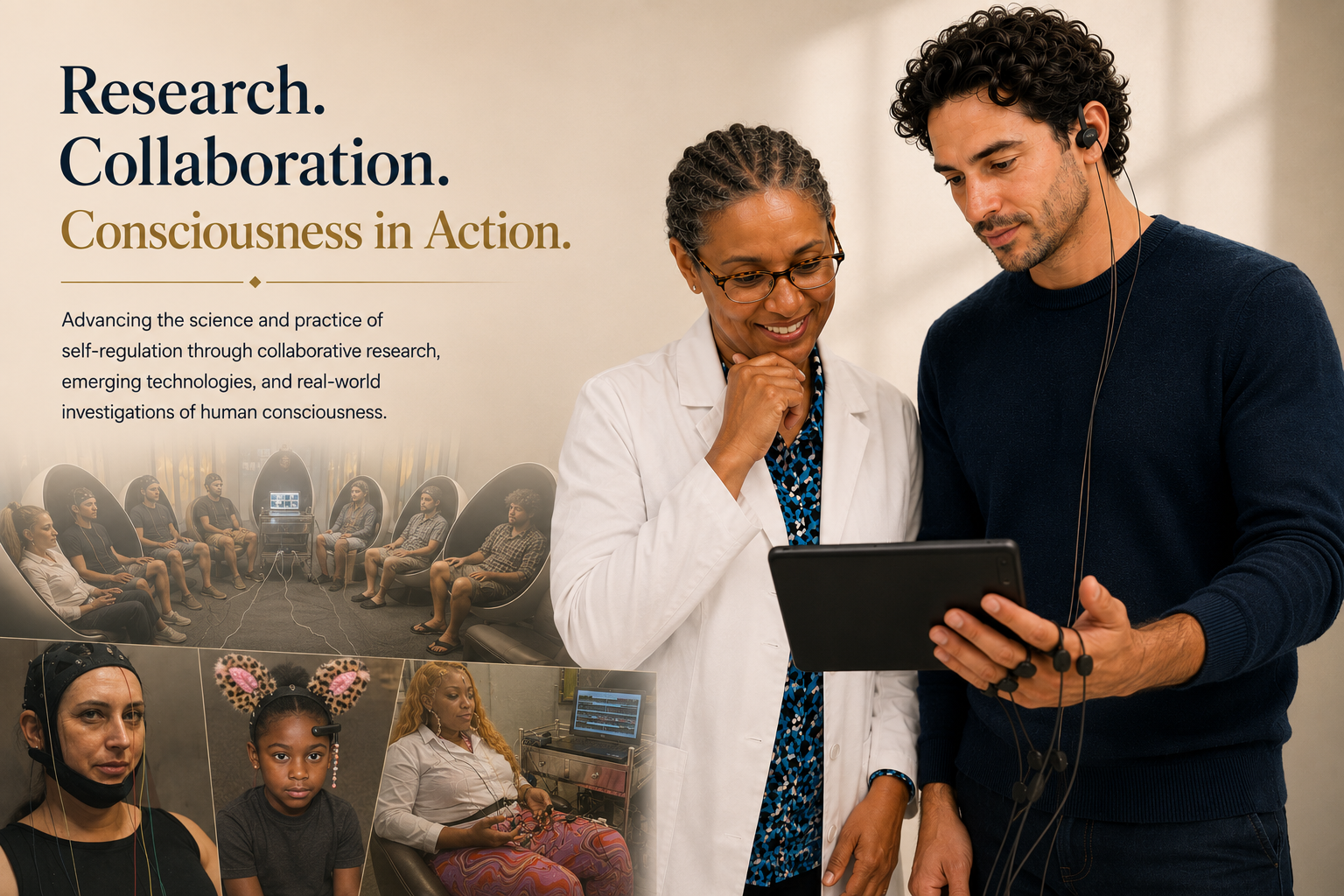
The Biofeedback Institute of Los Angeles (BILA) is actively developing collaborative research initiatives with laboratories, universities, clinicians, and interdisciplinary partners worldwide.
We believe scientific progress emerges through collaboration—the integration of diverse perspectives, methodologies, technologies, and lived experience. Our research efforts explore the evolving fields of psychophysiology, biofeedback, neurofeedback, human performance, and self-regulation.
We welcome partnerships with researchers, educators, clinicians, technology developers, students, and organizations interested in advancing scientific understanding and translating discoveries into meaningful applications.
Recent developments in consciousness research have encouraged BILA consultants to explore the application of psychophysiological monitoring across a wide range of performance, contemplative, and altered-state settings.
This archive features selected historical recordings and educational excerpts illustrating how Mind Mirror EEG has been used to observe distinctive brainwave patterns during meditation, artistic creativity, healing practices, and other exceptional states of consciousness.
These recordings are presented as opportunities for observation, discussion, and scientific inquiry rather than as proof of specific claims.
What does the brain look like during profoundly integrated states of awareness?
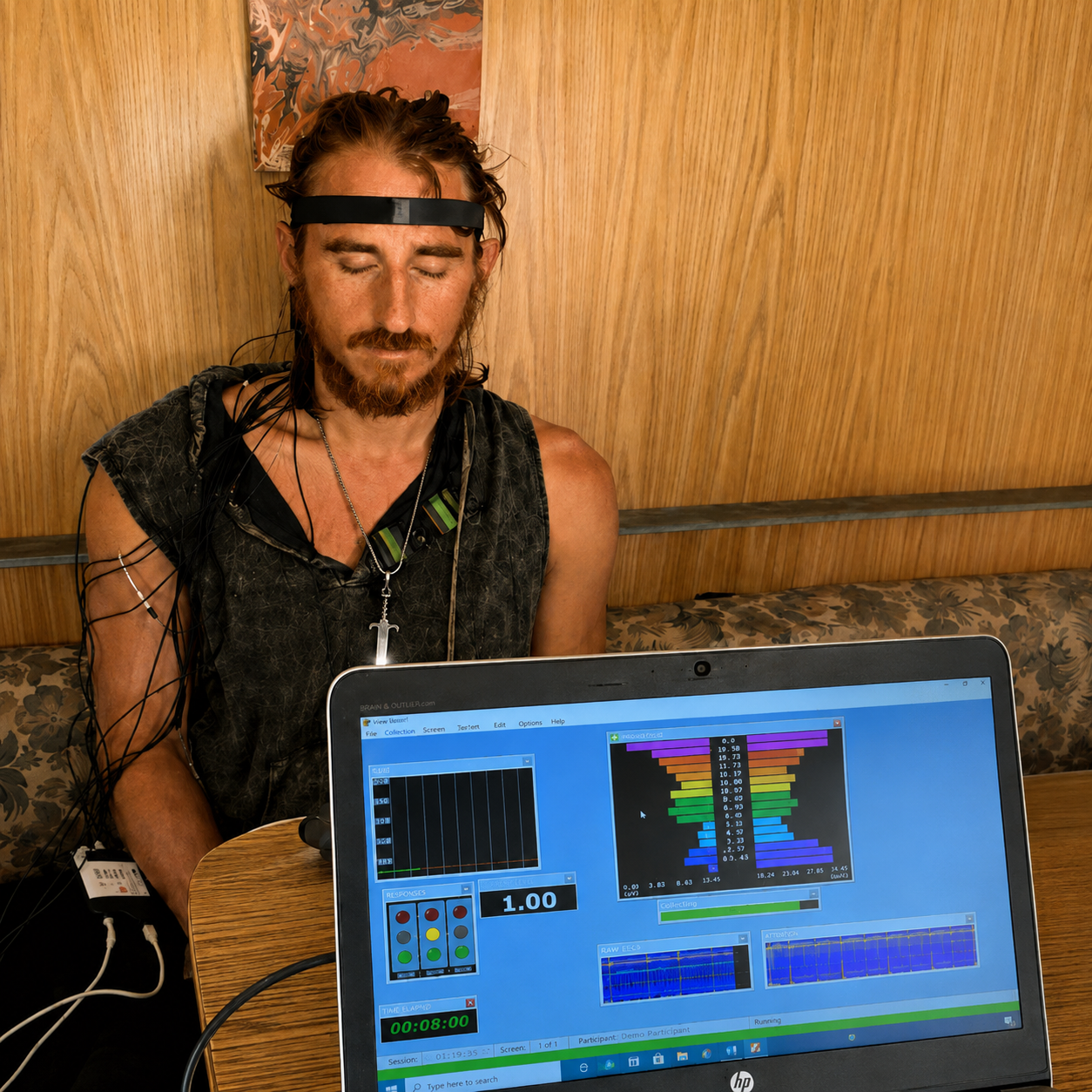
This case study documents an experienced contemplative practitioner whose meditation sessions produced exceptionally high-amplitude gamma activity using the Vilistus Mind Mirror 6, one of the few EEG systems specifically developed to study optimal and expanded states of consciousness rather than neurological pathology.
The Mind Mirror lineage traces directly to the pioneering work of British physicist C. Maxwell Cade and engineer Geoffrey Blundell, whose original instrument, introduced in the 1970s, was designed to identify reproducible brainwave signatures associated with advanced meditation, creativity, intuition, and higher states of awareness.
Unlike conventional clinical EEG systems, the Mind Mirror displays the dynamic relationships among frequencies across both hemispheres, allowing researchers to observe whole-pattern organization as consciousness changes in real time.
“Felt connection rather than belief is the critical variable… Once people start to connect with one another, they feel a connection to nature; they feel a connection to everything, and their whole perspective on life changes… this is transformation.”
The recording was obtained using a technology developed over five decades specifically to investigate the development of consciousness, making the findings part of a continuous research tradition that extends from Maxwell Cade’s original investigations to today’s Vilistus Mind Mirror 6 platform. Cade’s work shifted the question from “What does dysfunction look like?” to “What does the brain look like when a person is functioning at their highest potential?”
Within that historical context, Laughing Dragon’s recordings represent a contemporary example of the types of physiological patterns that consciousness researchers continue to investigate.

Gamma oscillations are the fastest commonly measured EEG rhythms and have been associated in neuroscience with attention, perceptual binding, working memory, and large-scale neural communication.
Rather than reflecting isolated brain regions, synchronized gamma activity is thought to support the integration of distributed neural networks into coherent cognitive states.
In advanced contemplative research, unusually coherent gamma activity has attracted particular interest because it may reflect highly organized cortical processing during sustained meditation.
The recordings in this case demonstrated gamma amplitudes and organization sufficiently distinctive to warrant further examination in the BILA archive.
This case is unique for another reason.
The EEG data do not stand alone.
They accompany a long-term personal journey involving disciplined meditation, systematic self-observation, and extensive documentation of subjective experience.
Rather than treating physiology and experience as separate domains, the BILA views them as complementary sources of information that together generate richer research questions.
Objective measurements and lived experience become two perspectives on the same process of transformation.
Biofeedback Recorded Sound Bath Session — Sundragon Technologies × Inner Wonders Company
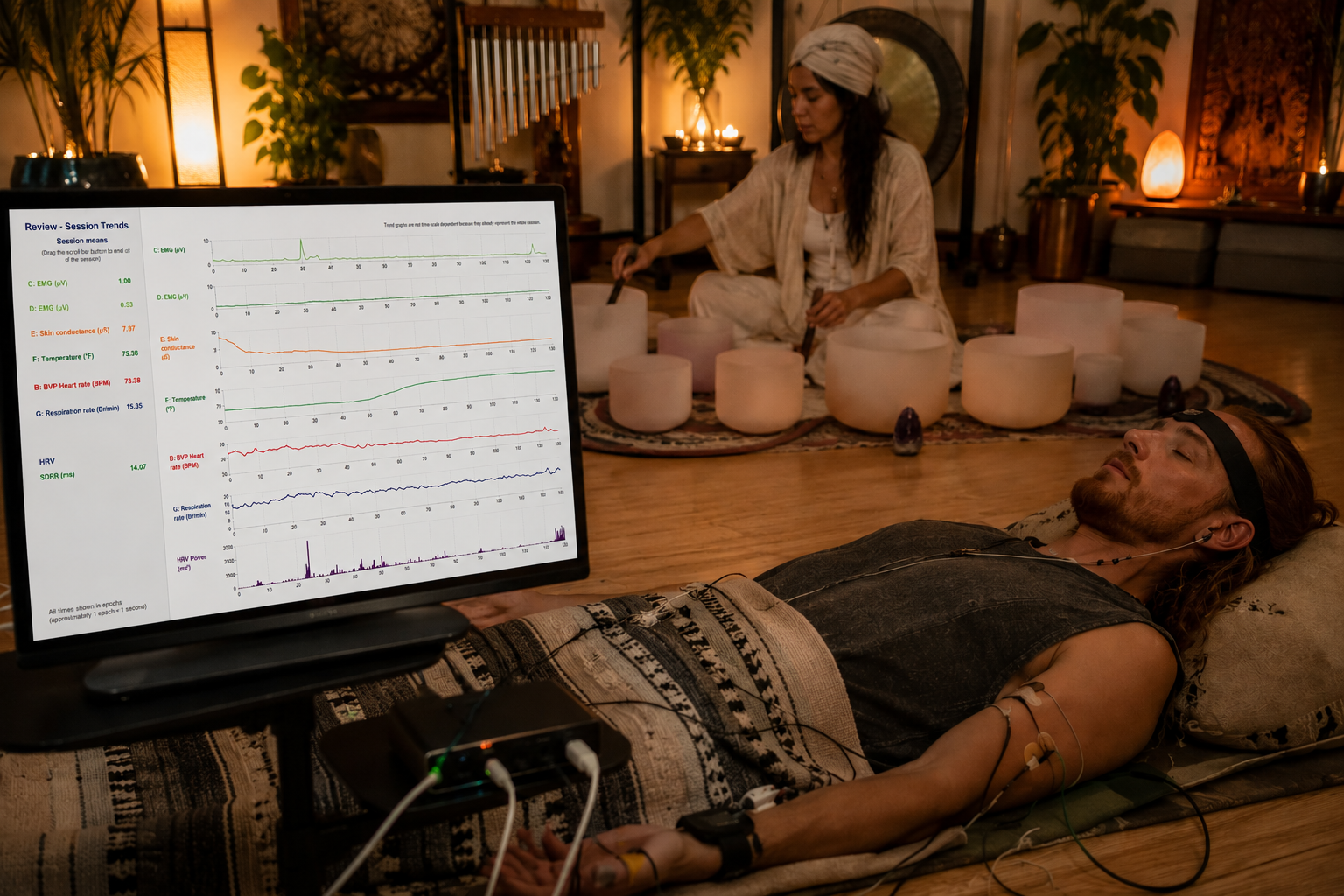
During a sound bath session, BILA recorded multiple physiological signals to examine how the participant’s nervous system changed across the experience.
Measures included skin conductance, peripheral temperature, heart rate, respiration, surface muscle activity, and heart-rate variability.
The recordings show a coordinated pattern of autonomic settling: skin conductance declined substantially, peripheral temperature increased, heart rate and respiration slowed, and muscle activity remained low.
Together, these changes suggest that the participant moved from an initially activated state into a more stable, physiologically regulated condition during the sound bath.
Sound baths are commonly described as calming, immersive, or meditative. Such descriptions are usually based on subjective experience.
This case study asks a more specific question:
BILA used multimodal psychophysiological monitoring to examine changes in autonomic arousal, cardiovascular activity, respiration, peripheral circulation, and muscle tension across a single sound bath session.
The recording does not establish that sound baths produce the same response in every person.
It does, however, document a clear and physiologically coherent pattern within this participant: several independent body systems changed together in a direction consistent with reduced sympathetic activation and increased autonomic regulation.
Multiple physiological signals were monitored throughout the sound bath session to observe changes in autonomic regulation.
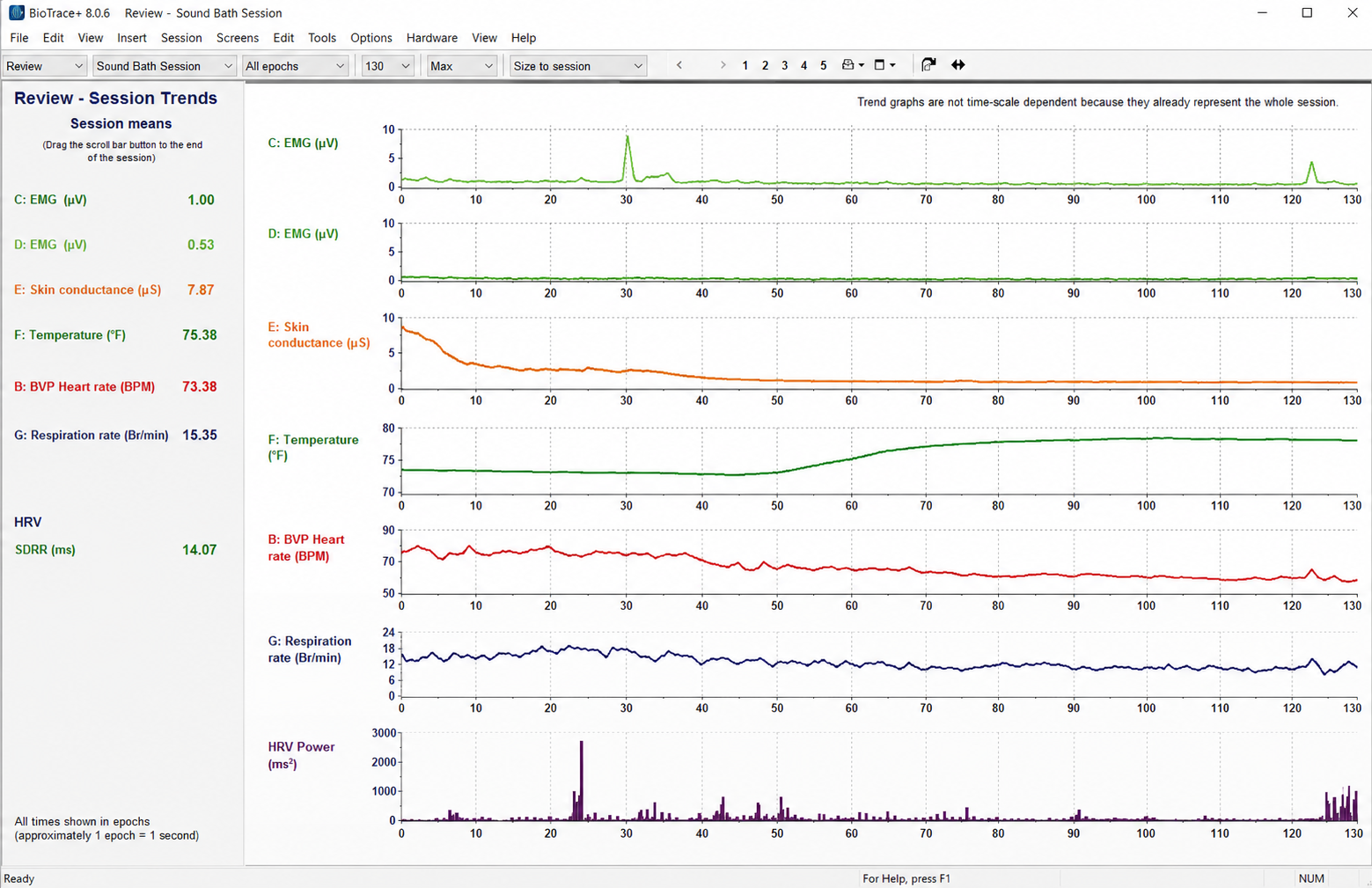
Skin conductance declined rapidly during the opening portion of the session before stabilizing at a much lower level.
Temperature increased gradually as sympathetic vasoconstriction decreased.
Heart rate gradually moved from the low 70s toward the low 60s.
Breathing became slower and more stable without deliberate respiratory control.
Muscle activation remained consistently low with only brief isolated peaks.
HRV remained relatively stable with brief transient increases during the session.
Together, these signals describe a coordinated transition from comparatively elevated activation toward a quieter, more stable physiological state.
The strongest interpretation is not simply that the participant “relaxed.” It is that multiple regulatory systems changed with different but physiologically compatible time courses:
Electrodermal arousal decreased rapidly.
Breathing and heart rate slowed progressively.
Peripheral circulation changed more gradually.
The resulting state was sustained through much of the session.
This sequence is consistent with the expected temporal organization of autonomic settling.
The Awakened Mind Pattern
This Mind Mirror EEG display illustrates the distinctive pattern identified by British psychobiologist and biophysicist C. Maxwell Cade: active low-beta awareness supported by strong, continuous alpha and deep theta activity.
Alpha forms the essential bridge between conscious thought and the imagery, intuition, and insight associated with theta—creating a state in which relaxed awareness and clear thinking coexist.
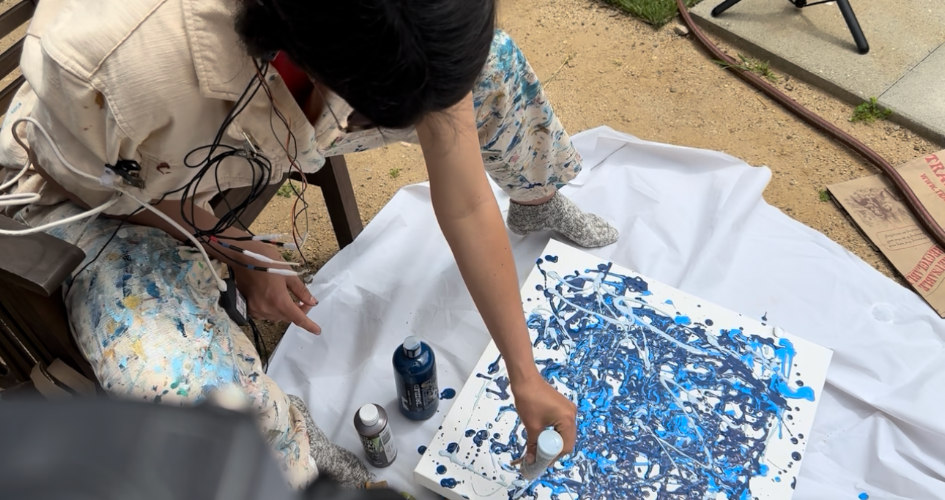
This case study follows an artist creating an original acrylic painting while spontaneously vocalizing what she describes as "light language."
Mind Mirror EEG recordings accompany the session, providing an opportunity to observe physiological activity during an immersive creative process.
Rather than interpreting the experience itself, the project examines measurable psychophysiological patterns associated with sustained creative engagement.
Do experienced meditators exhibit measurable similarities during shared contemplative practice?
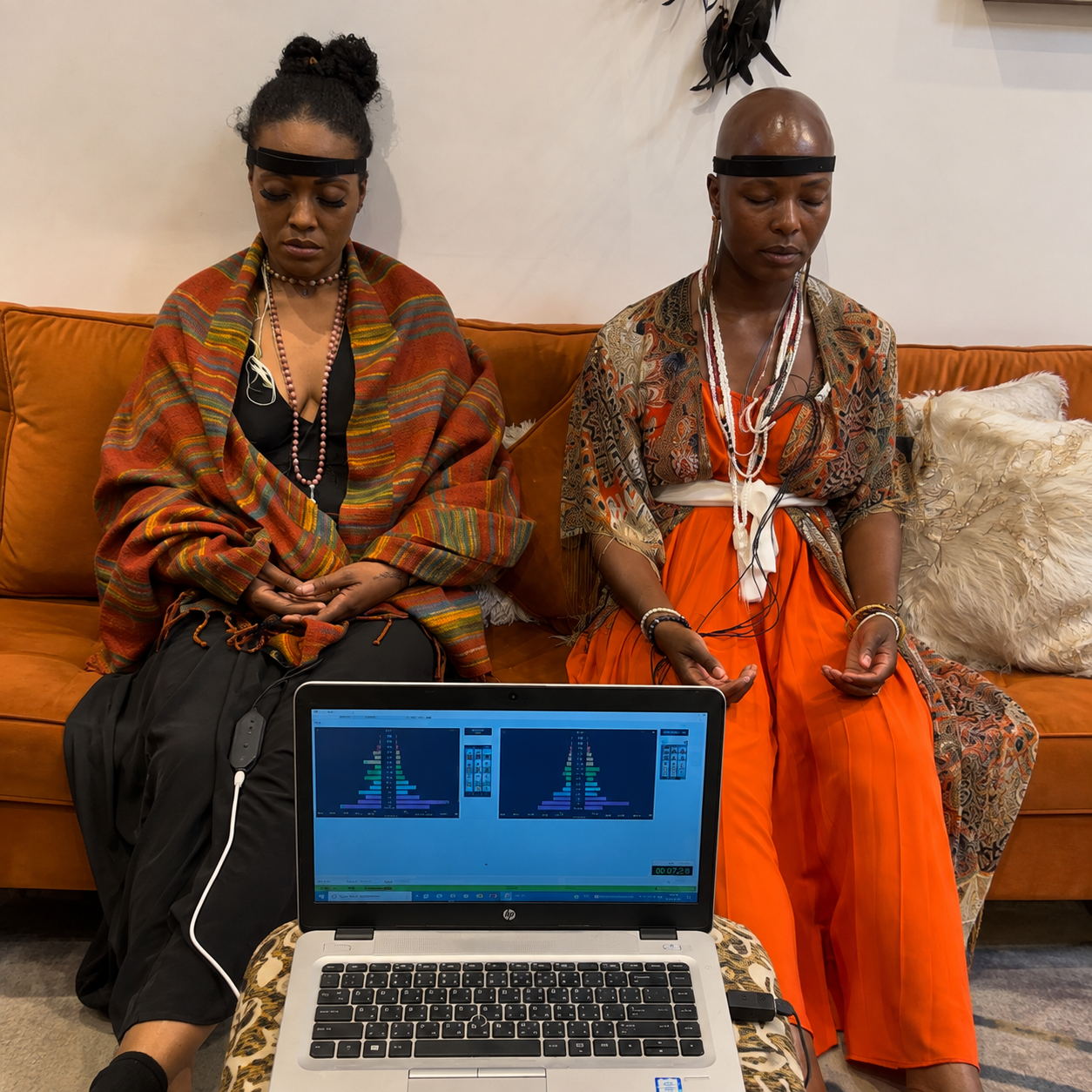
This exploratory recording documents simultaneous Mind Mirror EEG recordings from two experienced spiritual teachers during guided meditation.
Visitors can observe changing brainwave activity alongside the recorded session and consider how shared contemplative practices may influence psychophysiological organization.
.png)
Building on 50 years of pioneering research, the Biofeedback Institute of Los Angeles (BILA) empowers individuals by democratizing access to brain health and performance training. We provide evidence-based, affordable, and automated solutions that foster self-regulation, resilience, and an enhanced quality of life for our community and future generations
Historical Archive
Biofeedback Education
Skills Course
Gold Mind Brain Gym
Community Resources
info@biocompresearch.org
Biofeedback Institute of Los Angeles 501(c) 3
Preserving the Past. Advancing the Future.
© 2026 Biofeedback Institute of Los Angeles.